
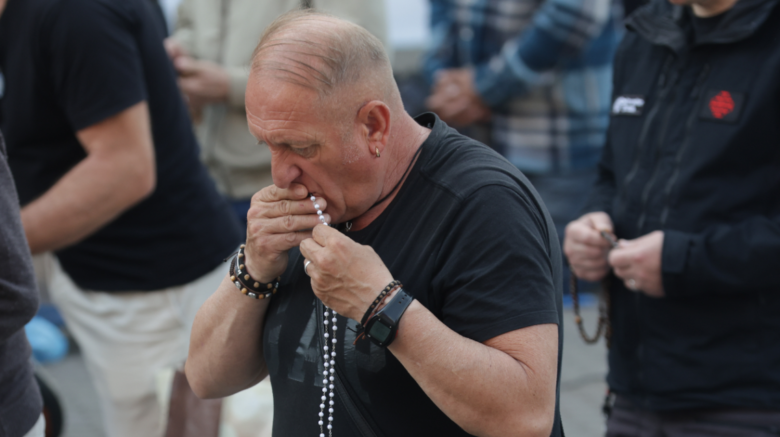
The Franciscan Spiritual and Pastoral Center Visoko made a very strong and significant announcement on its Facebook profile about the men’s public prayer at the “trg” (town square) Zagreb. The text that was written engraves itself into the heart, because the spoken words are the Truth.
Therefore, we are reproducing their announcement in its entirety:
Let He Who Has Ears Hear. Let He Who Has Eyes See.
For when a man kneels before the Lord – the heavens open. And the earth is no longer the same. Jesus is coming! And this world will never be the same
When Jesus healed the sick, healed, cast out demons and raised the dead, he would always warn the healed person afterwards not to tell anyone. He did not want people to become attached to Him because of signs and wonders. He encouraged faith to be based on His word, to be born in our hearts: “Blessed are those who have not seen and yet have believed!” (John 20:29). For “for this reason I have come to preach” (cf. Mk 1:38).
But when the final victory was to come, and when it did come, it came publicly. It came with pomp. The final victory did not come secretly. It came in agony, in bloody humiliation, in scourging (Jn 19:1), in spitting (Mt 26:67), in the crown of thorns (Jn 19:2), in mockery (Mt 27:29), in the cross – the instrument of shame that became the tree of life. “Christ redeemed us from the curse of the law, having become a curse for us – for it is written, ‘Cursed is everyone who hangs on a tree’” (Gal 3:13). The whole world then looked at the One who said that God was hanging crucified. And the world mocked him: “You who destroy the temple and build it in three days, save yourself! If you are the Son of God, come down from the cross!” (Mt 27:40).
But just then, in the moments of greatest darkness, heaven opened: “And behold, the veil of the temple was torn in two from top to bottom; and the earth shook, and the caves were split, and the tombs were opened, and many bodies of the saints who had fallen asleep were raised” (Mt 27:51–52). Sin was blotted out (cf. Heb 9:26). Satan was defeated and publicly exposed (Col 2:15). Man was redeemed (1 Cor 6:20). And this was not done in secret, but openly – before the eyes of the world – for this was the revelation of the eternal King: “And I, when I am lifted up from the earth, will draw all to myself” (Jn 12:32).
The victory came in such a way that the whole world of that time witnessed it – watched, rejoiced, mocked – because, behold, the One who presented himself as God cannot now save himself. But that was that walk: a walk to victory, a walk to eternity, a walk in which death was defeated, Satan was defeated, and humanity was redeemed. Heaven opened, and those who had been waiting in “Abraham’s bosom” could now stand before the face of the Lord.
That is why today those who are called kneelers kneel publicly. Until now they have kneeled in churches, in the privacy of their homes, alone, with families, with brothers and sisters, in the contrition and humility of a repentant heart – and that is what is most important: a humble heart that kneels before the Lord. Now they kneel publicly, under the spotlight of the world, renewing the face of the earth by carrying the burden of the suffering and persecution of the cross, conforming themselves to Jesus on his way of the cross, who fell under the weight of the cross – whipped – spat upon and mocked.
Evil was publicly defeated on the cross, and that is why many today rebel, complain, and shout that we should pray within the walls of churches and homes, that there is no place for public testimony of faith. They say that “faith is something personal, something that should remain hidden, silent, muffled,” while godlessness and worthlessness overpower everything with a running stride.
Faith is a personal relationship with God, but its implications are public, just as sin is personal, but its consequences are also public and overflow into society like a flood that breaks down all barriers. That is why the world is shaking, hell is shaking because of public prayer in the town square, because of the bulwark of faith and hope that stops the raging flood of sin.
It is at this point that we come to the fundamental error of those who today repeat the mantra that “we should pray within the walls,” and in doing so, they refer to Jesus’ words about praying in secret. Such an appeal shows that, unfortunately, they do not understand either Scripture or the One who spoke these words. Jesus is not talking about fleeing from the public sphere, but about entering the interior. When he says: “But when you pray, go into your room, and when you have shut your door, pray to your Father who is in secret” (Mt 6:6), he is not prescribing a space for prayer, but rather an anthropology of the heart. This “room” is not a built room, but the conscience, the inner sanctuary of man, the place where man lays bare before God, where he prays the Our Father with all his petitions that call for maturity, conversion, forgiveness and interior transformation. For how can you ever sincerely pray: “Forgive us our debts, as we also forgive our debtors” if you have not entered the depths of your own heart, faced with your own wounds, resentments and sins? Jesus, therefore, is talking about the secretness of the interior, and not about the prohibition of public witness.
The same pattern of misunderstanding also appears where people reduce Jesus’ words to the external, the tangible, and the measurable. When Jesus says, “Destroy this temple, and in three days I will raise it up,” they mock him because they are referring to the stones, the walls, and the years of construction (cf. Jn 2:19-21). And the Gospel makes it clear: “He spoke of the temple of his body.” So it is with prayer: the human body is the temple of the Holy Spirit (cf. 1 Cor 6:19), and the heart is the altar where God and man meet. Prayer in secret does not exclude public prayer—it is its prerequisite and its source. What is not born in the heart cannot be brought before the world; but what is kindled in the heart cannot remain hidden.
Therefore, appealing to “secretness” as an excuse for silence and withdrawal is cowardice and an abuse of the word of God. This is a selective citation that serves to justify one’s own lukewarmness, fear, or adaptation to the world, rather than obedience to the Gospel. “We are in the world, but not of the world.” It is precisely in this tension between faith and the world that the problem of many self-proclaimed “theologians and biblical scholars” of our time is revealed, who take the word of God out of its context, deprive it of its depth, and transform it into a means of silencing testimony. But the word of God is not a dead letter, but living and effective (cf. Heb 4:12): it penetrates to the core, reveals the intentions of the heart, and seeks the whole man — a heart that kneels in secret and a body that is not afraid to kneel publicly in the world.
Christ never called for a faith that is hidden from the world, but for a faith that is born from within and then becomes light: “A city set on a hill cannot be hidden” (Mt 5:14). Concealment is the source, not the goal. Prayer is born within, but it must not be stifled before it bears fruit — for what is truly of God, once ignited in the heart, inevitably illuminates the world.
And no, no power will stop the public recitation of the Rosary, for light has come into this world. Just as evil and sin were publicly defeated on the cross, so it will be with this godless society: openly, publicly, no longer only in the privacy of the home or church, but as men kneel and pray with rosaries in their hands in the squares, in the communion of believers in front of hospitals, the defeat of the world as we have known it is publicly proclaimed, and the birth of a new man who kneels in humility of heart before the King of kings, Lord of lords, the Lord Jesus Christ.
Today, the “men kneeling in prayer” publicly testify to the power of the Resurrection. Their prayer, once hidden within the walls of churches and family homes, now comes out into the squares and streets. They kneel with rosary in hand, facing ridicule, insults and condemnation, just as Jesus was exposed to the evil noise of the world. Just as the whip tore the skin of Jesus, so today, impiety tries to penetrate their prayers, the enclosure of the public spiritual altar on which the sin of the world is offered on the victorious cross. The media mock their act, as they once mocked Jesus: “He who claimed to be God cannot save himself” (cf. Mt 27:40).
But Jesus’ humiliation brought the glory of the cross, the victory over evil. Likewise, the humiliations of the “men kneeling in prayer” carry the echo of that victory. Their humility is stronger than any force that wants to stop them. For every man who kneels before the Lord is no longer trapped by the fruit of disobedience that has distanced him from God. He bears witness to God’s original plan: that man leads creatures towards unity with the Creator and eternal communion in the joy of the children of God. He is a man whose heart, soul and body are renewed by faith, hope and love.
Kneeling is not a random act, it is not a trick or a whim. It comes from a time of preparation – from a time of the desert in which the soul is shaped by prayer, silence and trials. Just as Jesus was tempted by the Evil One in the desert, but defeated him with the truth of God’s word, so too does the man who kneels pass through his inner desert. In that desert he is tempted by his own weaknesses, the voices of the world and doubts, but God’s grace leads him to the cross, to victory. From the desert, from the silent encounter with God’s whisper, the strength for public witness is born.
In this public act of kneeling, men, with the power of the rosary – the spiritual chains that bind the satans of this world – testify that there is no power that can overcome the light of God’s grace, justice and mercy. The prayer that sprouted in secret now echoes in the squares. It is the journey of the heart along Jesus’ way of the cross towards Golgotha, a preparation for the celebration of the victory on the cross.
Let us remember the scene when the Pharisees brought the adulteress to be condemned. The world then judged relentlessly, looking for a stone to be used for execution. But Jesus, the only true Judge, stoops down and writes on the ground: “He who is without sin among you, let him be the first to throw a stone at her” (Jn 8:7). And while the world judges, Jesus heals and forgives, because “God did not send the Son into the world to judge the world, but that the world through him might be saved” (Jn 3:17).
He calls for conversion, he forgives everyone because his closeness awakens hope and joy in the converted and repentant heart. His bowing to the ground symbolizes humility and closeness to those despised by society. He shows us God who descends from heaven and comes to earth in the humility of the Bethlehem manger – to bring new life to everyone who believes (cf. Lk 2:7).
“And the Word became flesh and dwelt among us, and we saw his glory – the glory as of the only Son from the Father – full of grace and truth” (Jn 1:14).
The adulteress believed. She called him Lord, unlike the Pharisees who witnessed his miracles and sermons but did not acknowledge him as Lord. It was easier for them to call him and acknowledge him only as Teacher than as God, thus revealing their own sinfulness before others. But Jesus saw through them: “Who is without sin…” – and they left, one by one, starting with the oldest (cf. Jn 8:9). They did not dare to throw a stone because then their appearances of holiness would fall, their masks would fall.
The adulteress knelt. She did not flee, although she could have. The worst was over – she survived, no one stoned her. But she felt the grace, the closeness and the mercy of the Lord. He, the only one without sin, did not condemn her either: “Neither do I condemn you. Go and sin no more” (Jn 8:11).
For he did not come to condemn the world, but to save it – and to raise man again from the mire of sin to the dignity of a child of God.
There are many opponents – even among so-called Catholics – who oppose public prayer in the squares, saying that prayer should be in secret, not understanding that Jesus is talking about the secret of the heart, and not necessarily of space. For He who says: “But when you pray, go into your room…” (Mt 6:6), also says: “Let your light so shine before men, that they may see your good works and glorify your Father who is in heaven” (Mt 5:16).
The apostles prayed in the Upper Room, but they also prayed in the marketplaces, boldly proclaiming the risen Lord (cf. Acts 2:14; 3:1-11). Kneeling in public places becomes a prophetic sign – an external expression of interior grace – like a lamp placed on a lampstand (cf. Mt 5:15).
There is no power that can stop a man who kneels before God. There is no system, no regime, no law, no darkness that can overcome the light that shines from a kneeling heart. The seeds of faith, hope and love have already been sown. And they have grown. And they bear fruit – the fruit of the renewal of the family, the people and the homeland. The man who kneels no longer eats the fruit of disobedience. He guards and cultivates the garden entrusted to him by God. With a rosary in his hand and humility in his heart, he paves the way for a new humanity that glorifies Jesus Christ, King of kings and Lord of lords.
Just as evil was publicly defeated on the cross, so it will be with the ungodly structures of this time. Publicly!
The men who kneel with a rosary in their hands do not provoke the world—they call it to conversion. Their kneeling is not a political act, but a liturgy of the heart poured out into the public space. It is a proclamation that there is a King before whom every knee bows.
“Therefore God has highly exalted him and bestowed on him the name that is above every name, that at the name of Jesus every knee should bow, of those in heaven and on earth and under the earth” (Phil 2:9–10).
Kneeling is our response. Our offering. Our cross.
Because when a man kneels before the Lord, heaven opens. And the earth is no longer the same. Jesus is coming! And this world will never be the same again.
Krist Pavlvs Dodaj